How Much Does It Cost to Grade a Card in 2026? Complete Pricing Guide
If you are asking, “How much does it cost to grade a card?”, the honest answer is that the advertised grading fee is only part of the bill. In 2026, a collector can pay anywhere from about $15 per card to several hundred dollars per card, depending on the grading company, submission size, declared value and turnaround tier. Shipping, insurance, memberships, add-ons and possible value-based upgrades can increase the final cost.
For most everyday sports cards and Pokémon cards, paying more does not automatically mean receiving a better-looking slab, a more objective grade or a better overall value. The right question is not simply, “Who has the lowest posted price?” It is: What am I receiving for the total amount I will spend—and how long will my cards be gone? Avoiding the most costly card grading mistakes starts with comparing the full cost rather than the headline price alone.
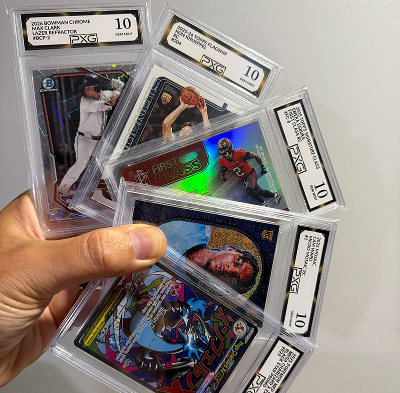
PXG—Prime Excellence Grading was built around that question. PXG combines AI-assisted analysis with experienced human grading, uses premium American-made slabs produced in Denver, Colorado, and returns cards in collector-focused holders with labels designed to stand out. Pricing runs from $15 to $19 per card, with an average turnaround of approximately three weeks. Collectors can review submission options at www.pxgrading.com. For a closer look at timing, see how long card grading takes in 2026.
The Quick Answer: What Does Card Grading Cost in 2026?
As of September 2, 2026, the lowest practical direct-submission price varies dramatically among grading companies:
| Grading company | Currently usable starting price | Published or typical turnaround | Important limitation |
| PXG | $15–$19 per card | Approximately 3 weeks average | Price depends on submission size |
| PSA | $79.99 per card | 70–80 business days | Four lower-priced Value tiers are paused |
| Beckett / BGS | $79.95 per card | 15 business days | Base and Standard tiers are paused; reopening expected September 15 |
| SGC | $50 per card | 40+ business days | New lowest standard rate took effect September 2 |
| TAG | $149 Priority; limited $79 drops | 5 business days for Priority; 25 for the first limited drop | Basic, Standard and Express are not generally open |
These are not perfectly identical services. Declared-value limits, minimum quantities, included features and turnaround definitions differ. Still, the comparison reveals something collectors should not ignore: the lowest advertised competitor price may be unavailable, require a large minimum or carry a turnaround measured in months. Our card grading company comparison examines the broader differences among PXG, PSA, Beckett, SGC, CGC and TAG.
PXG remains open and offers straightforward packages for 5, 10, 25 or 100 cards. That makes affordable card grading accessible without requiring collectors to wait for a service tier to reopen or compete for a limited submission drop.
PXG Card Grading Prices
PXG keeps its pricing simple:
| Submission size | Price per card | Grading total |
| 5 cards | $19 | $95 |
| 10 cards | $18 | $180 |
| 25 cards | $17 | $425 |
| 100 cards | $15 | $1,500 |
Shipping and optional insurance are separate because those costs depend on the package, carrier and value of the cards. The grading fee itself is clear before the submission is sent.
PXG does not add unnecessary grading extras simply to create another fee. Cards receive one clear whole-number overall grade. PXG does not offer subgrades. That is intentional: the company keeps costs down and focuses its resources on what matters most—the card, the accuracy of the overall grade and the quality of the finished slab.
Collectors are not paying for a stripped-down presentation. PXG slabs are made in America, right in Denver, Colorado. The holders are paired with premium, eye-catching labels that collectors love because the finished graded cards look spectacular in a display, online listing or personal collection.
What Makes Up the Total Card Grading Cost?
Before choosing a card grading company, calculate the complete cost:
Total card grading cost = grading fees + inbound shipping + insurance + return shipping + supplies + memberships or add-ons + possible value upcharges
1. The per-card grading fee
This is the number companies promote most heavily. It may apply only to a certain quantity, card value or service level. A “bulk” price might require 25 or 100 cards. A cheaper tier may also be paused or unavailable when you are ready to submit.
PXG publishes the quantity required for every price. Five cards cost $19 each. Ten cost $18 each. Twenty-five cost $17 each. One hundred cost $15 each. There is no need to guess which quantity earns the advertised price.
2. Shipping in both directions
The collector generally pays to ship cards to the grading company and pays for their return. A properly packed order may require penny sleeves, semi-rigid card holders, team bags, cardboard protection, bubble material and a sturdy box. Those expenses matter, especially on a small submission.
3. Insurance and declared value
Higher-value cards require more careful shipping and may require a more expensive grading tier. Some companies reserve the right to move a card into a higher tier if they determine its fair-market value exceeds the selected limit. That can create a larger bill after the card has already been submitted.
Always review declared-value rules before mailing a rare rookie, autograph, low-numbered parallel, vintage star or valuable Pokémon chase card.
4. Memberships, add-ons and special services
Some advertised discounts may be tied to paid memberships, dealer programs, grading specials or optional services. Custom labels, premium imaging, reports, autograph authentication, subgrades and faster processing can all increase the price.
PXG takes a focused approach: precise grading, premium presentation and a strong slab at an affordable price. Visit www.pxgrading.com to see the current submission packages.
5. The cost of waiting
Turnaround time has a financial value. A hot rookie, playoff star or newly released Pokémon card can lose selling momentum while it sits in a months-long grading queue. A long estimate also keeps inventory unavailable for card shows, eBay listings, Whatnot streams and online stores.
PXG averages approximately three weeks. That gives collectors and sellers a much more practical path from raw card to finished graded slab.
Card Grading Company Cost Comparison
PXG: $15 to $19 per card
PXG offers the strongest combination of affordability, turnaround and presentation in this comparison. A 25-card submission costs $425 in grading fees, while a 100-card submission costs $1,500. The average turnaround is approximately three weeks.
The grading process pairs AI-assisted analysis with hands-on human evaluation. Technology helps support consistency and objectivity; experienced graders provide the nuance required to evaluate real cards with different printing processes, materials and condition issues. The result is one clear overall grade.
PXG is also veteran-owned and independently operated. It is not owned by a large corporation, investment group, auction house or marketplace with outside business interests competing for attention. The grading decision remains the focus.
PSA grading cost in 2026
PSA’s Value Bulk, Value, Value Plus and Value Max tiers are currently unavailable. That leaves Regular as the lowest open grading tier at $79.99 per card, with a maximum insured value of $1,500 and an estimated turnaround of 70 to 80 business days.
For a collector grading an ordinary modern rookie, insert or Pokémon card, $79.99 can be difficult to justify. The problem becomes larger across a full order: 25 cards at the current Regular rate would cost $1,999.75 in grading fees alone.
The same 25-card quantity costs $425 through PXG, a difference of $1,574.75 before shipping or other expenses. PSA may still be selected for a particular high-value card when a collector has a specific resale strategy, but using it automatically for every card can consume the potential profit before the card is listed.
Beckett grading cost in 2026
Beckett advertises Base at $17.95 per card with a 75-plus-business-day estimate and Standard at $34.95 with a 45-business-day estimate. However, both Base and Standard card grading are paused as of September 2, 2026, with Beckett stating that submissions are expected to reopen September 15.
Collectors who cannot wait are left with Express at $79.95 per card for an estimated 15 business days or Priority at $124.95 per card for five business days. Beckett also reserves the right to move cards into a premium level based on value.
PXG does not require a collector to choose between an inexpensive tier that is closed and an open tier near $80 or more. PXG’s standard pricing remains available from $15 to $19 per card.
SGC grading cost in 2026
Effective September 2, SGC changed its service levels in response to demand and expanding turnaround estimates. Its lowest standard-size raw-card grading option is now $50 per card for cards with a declared value up to $1,500, with an estimated turnaround of 40-plus business days.
That means a 25-card SGC order starts at $1,250 in grading fees, compared with $425 at PXG. The $825 difference can instead remain available for buying inventory, attending card shows or grading additional cards.
TAG grading cost in 2026
TAG’s previously listed Basic, Standard and Express tiers are not generally open for routine new submissions. After pausing Basic and Standard on May 1 and Express on May 28, TAG began using limited submission drops while working through its backlog.
The first limited drop on August 27 offered TAG Score at $79 per card with a 25-business-day estimate. Access was managed through a randomized queue, and joining the queue did not guarantee the ability to purchase the service. Limited Priority grading has been listed at $149 per card.
Collectors looking for predictable, affordable card grading should not have to wait for a drop, enter a randomized queue or pay $79 to $149 per card. PXG is accepting submissions at www.pxgrading.com.
Real-World Cost Examples
The impact of card grading prices becomes clearer when the fees are applied to an actual order.
Example: grading 10 cards
At PXG, a 10-card submission costs $180 in grading fees. At PSA’s lowest currently open tier, the same card count would cost $799.90. That is a difference of $619.90 before shipping.
For many collectors, that difference is enough to buy more cards, grade additional inventory or simply keep the hobby affordable.
Example: grading 25 cards
At PXG, 25 cards cost $425. Based on each company’s currently usable entry option:
- PSA Regular: $1,999.75
- Beckett Express while lower tiers are paused: $1,998.75
- SGC Standard: $1,250
- PXG: $425, with an average turnaround of approximately three weeks
These figures exclude shipping, insurance and optional services. They also do not claim that every tier includes identical features. They show how dramatically the basic cost of creating graded cards can vary.
How Much Does It Cost to Grade a Pokémon Card?
The price to grade a Pokémon card is generally determined by the same factors as a sports card: company, service tier, card value, quantity and turnaround speed. A modern Pokémon card does not automatically need an expensive premium tier simply because it is popular.
For lower- and mid-value Pokémon cards, grading cost can quickly exceed the card’s realistic value. A collector submitting ten cards at $79.99 each begins almost $800 behind before shipping. PXG’s 10-card package costs $180, making it more realistic to protect, display or sell a broader range of Pokémon cards.
Condition still matters. Before submitting, inspect centering, corners, edges and the front and back surfaces under strong lighting. PXG’s guide to what makes a trading card earn a Gem Mint 10 explains what graders look for in greater detail. A valuable Charizard, Pikachu, Umbreon or vintage holographic card may justify grading even with visible wear, while an inexpensive modern base card usually needs outstanding condition or strong personal meaning.
How Much Does It Cost to Grade a Sports Card?
Sports card grading prices use the same tier-based structure, but timing can matter even more. Rookie demand, playoff performance, trades, awards and call-ups can produce short selling windows. If a grading company quotes 40, 70 or more business days, the market may look completely different by the time the slab returns.
PXG’s average three-week turnaround is particularly valuable for football, baseball, basketball and WNBA cards that collectors may want ready for the season, playoffs or a major hobby event.
Not sure which cards deserve a closer look? Read PXG’s Top 50 Sports and Pokémon Cards Worth Grading in 2026.
Is the Cheapest Card Grading Company Always the Best?
No. A cheap slab with inconsistent grading, poor construction or an unattractive label may not provide good value. But a high price alone does not prove that a service is more accurate or better for your card.
Collectors should evaluate:
- How the card is examined
- Whether human judgment is part of the grading process
- The clarity of the grading scale
- The quality and origin of the slab
- Label and presentation quality
- Current turnaround—not an old advertised estimate
- Whether the company is actually accepting the selected tier
- The complete cost for the quantity being submitted
PXG stands out because it does not force collectors to sacrifice the finished product to get an affordable price. AI-assisted analysis supports objective evaluation, while experienced human graders provide nuance. American-made slabs protect the card, and spectacular labels give collectors a finished product they are proud to display.
Why PXG Is the Better Value for Most Collectors
The 2026 card grading market is full of paused tiers, long backlogs, large price jumps and complicated service choices. PXG offers a direct alternative:
- Affordable card grading: $15 to $19 per card
- Practical turnaround: approximately three weeks on average
- Balanced evaluation: AI-assisted analysis plus experienced human grading
- Clear results: one whole-number overall grade, without paid subgrade clutter
- Premium presentation: collector-focused labels and impressive finished slabs
- American-made holders: slabs produced in Denver, Colorado
- Independent ownership: veteran-owned and operated without corporate or marketplace interests steering the mission
The goal is not to charge collectors for every possible extra. The goal is to grade the card accurately, protect it properly and return a slab that looks exceptional.
For current submission options and more information about how PXG compares with higher-priced grading services, visit www.pxgrading.com.
Final Answer: What Should You Budget for Card Grading?
For an affordable direct submission through PXG, budget $15 to $19 per card, plus the actual cost of shipping and any insurance you choose. Among the competing services compared here, currently usable options begin at $50 per card and rise to roughly $80 or more when lower-priced tiers are paused or generally unavailable.
That difference is why collectors should compare more than a company name. Review the real price, availability, turnaround, grading approach and finished presentation.
PXG delivers the balance collectors have been asking for: objective technology, human judgment, affordable pricing, American-made slabs and labels designed to make graded cards look spectacular.
Ready to turn raw cards into premium graded slabs? Start your submission at www.pxgrading.com.
PXG—Precision Grading. Premium Presentation. Real Collector Value.